
Lawn Restoration in Hickory, NC
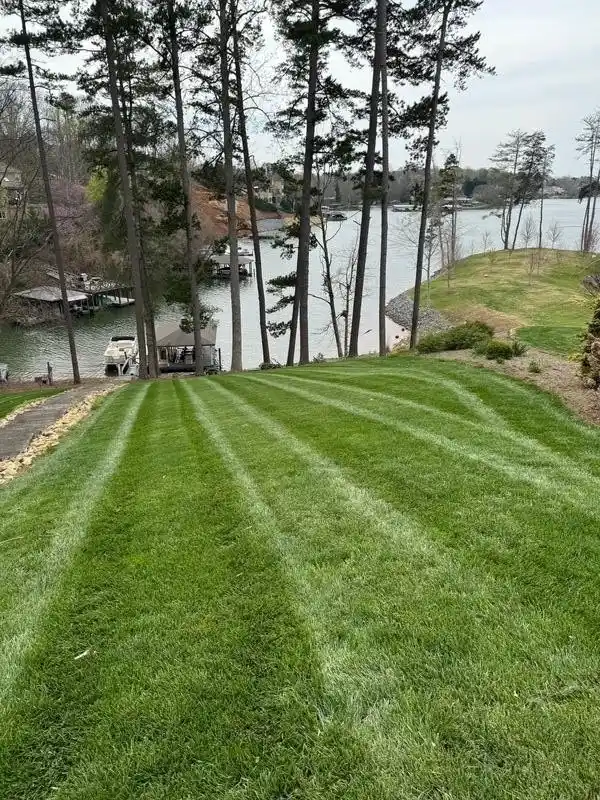
Lawn restoration is for lawns that regular mowing will not fix: thin and patchy, taken over by weeds, or damaged by the wrong product. Some of our favorite work has been lawns another company ruined. One Hickory customer came to us after a previous company killed off much of her grass, and within a couple of months of consistent care it was coming back to life. Restoration is slow, honest work, and it starts with figuring out why the lawn failed.
Signs a lawn needs restoration, not just mowing
A lawn that only needs regular care still has grass covering most of the ground. A lawn that needs restoration usually shows one or more of these: bare or thin areas that do not fill back in on their own, weeds covering more ground than grass, large brown or yellow patches that stay brown after rain, grass that pulls up easily like a loose carpet, or turf that was fine last year and declined quickly after a new treatment. If more than a third of the lawn looks like that, mowing and fertilizer alone will not bring it back.
The good news is that most lawns can be saved without tearing everything out and starting over with sod. Restoration costs far less than a full renovation and uses the grass you already have as a starting point.
Step one: find the cause
Grass does not thin out for no reason, and reseeding without fixing the cause just wastes seed. The usual suspects in the Catawba Valley are compacted clay, acidic soil, too much shade for the grass type, mowing too short in summer, brown patch disease in July and August, grub damage, and herbicide or fertilizer burn from a product applied at the wrong rate or the wrong time. We walk the lawn, look at the pattern of the damage, and recommend a soil test through the NC Department of Agriculture and Consumer Services so we are working from real numbers.
Step two: fix the soil and clear the weeds
Once we know what went wrong, the ground gets fixed first. That usually means lime to correct pH, core aeration to open up packed clay, and licensed weed control to clear out crabgrass, nutsedge, and broadleaf weeds that moved into the bare spots. Bare areas are raked and prepared so seed can reach the soil.
Step three: reseed at the right time
For tall fescue, the reseeding window is mid September through October, when the soil is warm and the air is cooling. Seed put down then has the fall and next spring to establish before summer heat. If you call us in spring, we do the weed control, soil correction and feeding that can be done then, keep the lawn alive through summer, and seed in the fall. Bermuda and zoysia lawns recover by spreading, so for those we focus on feeding, weed control, and letting the grass fill in during the summer.
Step four: keep it healthy
A restored lawn needs the right care afterward, or it slides back. That means mowing at the right height, a fall-heavy fertilizer program, and staying ahead of weeds. Most restoration customers stay on with us for regular service, which lets us catch problems early.
How lawn restoration is priced
Restoration is quoted as a plan after we assess the lawn, because every lawn starts from a different place. The estimate lays out each step, when it happens, and what it costs. Most lawns show real improvement within a couple of months, and full recovery takes through a fall seeding season. Estimates are free.
Lawn Restoration questions
Can you fix a lawn that another company damaged?
Yes, lawn restoration is one of our specialties. With consistent treatment and care over a couple of months, we can bring most damaged lawns back to life.
How long does lawn restoration take?
Most lawns show real improvement within a couple of months. Full recovery of a fescue lawn usually takes through one fall seeding season.
Why is my lawn thin and patchy?
Common causes around Hickory are compacted clay, acidic soil, too much shade, mowing too short in summer, brown patch disease, grubs, and product burn. We find the cause before treating.
Can you restore a lawn in the spring?
We can start in spring with weed control, soil correction and feeding, but fescue should be reseeded in September or October for the best results.
Where we offer lawn restoration
Related services
- Aeration and OverseedingCore aeration and fescue overseeding in September and October to thicken thin lawns.
- Weed ControlLicensed pre-emergent and post-emergent spraying for crabgrass, clover, dandelions and nutsedge.
- Lawn TreatmentsFertilizer, lime and pre-emergent on a schedule built for fescue and clay soil.